
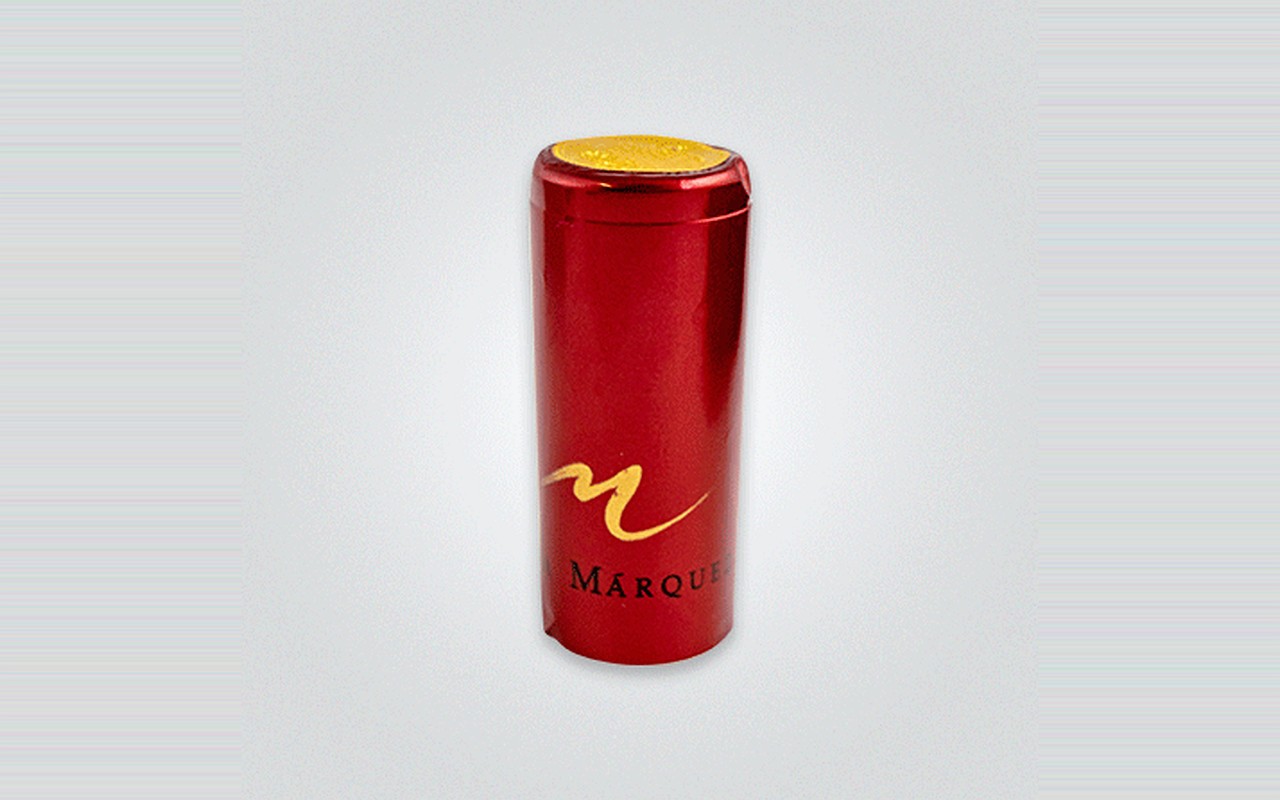
Aluminium Capsules, Corks & Wine Closures
The three centimetres a customer sees before they read a single word: the capsule, the crest stamped into it, and the cork that decides how the wine ages.
The capsule is the first thing the hand touches
A wine capsule does three jobs at once. It hides the cork and the bottle finish, which are never beautiful. It signals price tier before the label is read — a heavy polylaminate with a hot-stamped crest reads as expensive from two metres away. And it provides a tamper indication that the trade expects.
The material choices are polylaminate (aluminium and polyethylene layers, the premium standard), pure aluminium, tin for the very top tier, and heat-shrink PVC or polylaminate for value tiers. Each takes decoration differently: embossing, debossing, hot stamping, litho printing on the skirt and printed or embossed tops.
The detail people forget is the bottle finish. A capsule is sized to a specific bore, neck diameter and finish profile, and a capsule sized for a Bordeaux finish will not sit correctly on a Burgundy one. We size against your actual bottle, not against a nominal drawing.
Cork is a closure decision, not a cosmetic one
Natural cork remains the classic for wines intended to age, because it allows a controlled, very small oxygen ingress that shapes how a wine develops over years. It is also a natural product with natural variance, and quality grades matter enormously.
Technical and agglomerated corks — micro-agglomerated bodies, sometimes with natural discs on the ends — give far more consistent oxygen transmission and far lower TCA risk, which is why an enormous share of quality wine now uses them for anything intended to be drunk within a few years. For most commercial wines this is the rational choice.
Screw caps are neither a downgrade nor a shortcut. They give the tightest and most consistent seal available, they eliminate cork taint entirely, and in several markets they now dominate premium white wine. If your positioning allows it, they are technically excellent — and the liner inside them is itself an oxygen-transmission specification you can choose.
Branding the closure and matching it to the label
Corks can be fire-branded or ink-printed with your estate name, vintage and logo — a detail that costs very little and that the customer discovers at the moment of opening, which is the most emotionally loaded moment your packaging will ever have.
Capsules can be embossed and hot stamped with the same crest that appears on the label. Because we print the label, the capsule and, where you use one, the bag-in-box case, that crest is one artwork run against one colour target rather than three interpretations by three suppliers.
For wineries in Baja California and Southern California this consolidation matters commercially as well as aesthetically: one supplier, one purchase order, one delivery, one point of accountability when a bottling date is fixed and something is late.
What this product includes
Typical applications
- Estate and reserve wines needing a premium capsule and cork programme
- Commercial wines using technical corks or screw caps
- Mezcal, tequila and craft spirits with branded closures
- Olive oil bottles using capsules and pour spouts
- Limited editions and vintage-dated capsule runs
- Private-label and export programmes with market-specific panels
Films, resins and finishes
- Polylaminate capsules in gloss, matte and brushed finishes
- Pure aluminium and tin capsules for top-tier bottlings
- Heat-shrink PVC and polylaminate capsules for value tiers
- Graded natural cork in several lengths and diameters
- Micro-agglomerated technical corks with controlled oxygen transmission
- Screw caps with selectable liner types and printed skirts
Frequently asked questions about aluminium capsules & corks
Yes, because we print both. The crest is one piece of artwork, run against one signed colour target, hot stamped on the capsule and printed or foiled on the label. When two suppliers do it, you get two interpretations of gold.
A micro-agglomerated technical cork is usually the rational choice: consistent oxygen transmission, very low taint risk and a lower cost than graded natural cork. Natural cork earns its premium on wines built to age for many years.
Yes, with a choice of liner, which is the part that actually determines oxygen ingress. We will discuss the liner against the style of wine rather than treating a screw cap as a single product.
We ask for physical bottles. Bore, neck diameter, finish profile and skirt length are measured on the real glass, because nominal drawings and actual glass differ by enough to make a capsule sit crooked or refuse to spin down.
Let's spec your packaging
Send us the product, the process and the volume. You get a structure proposal, a tooling cost and a lead time within 24 business hours.