
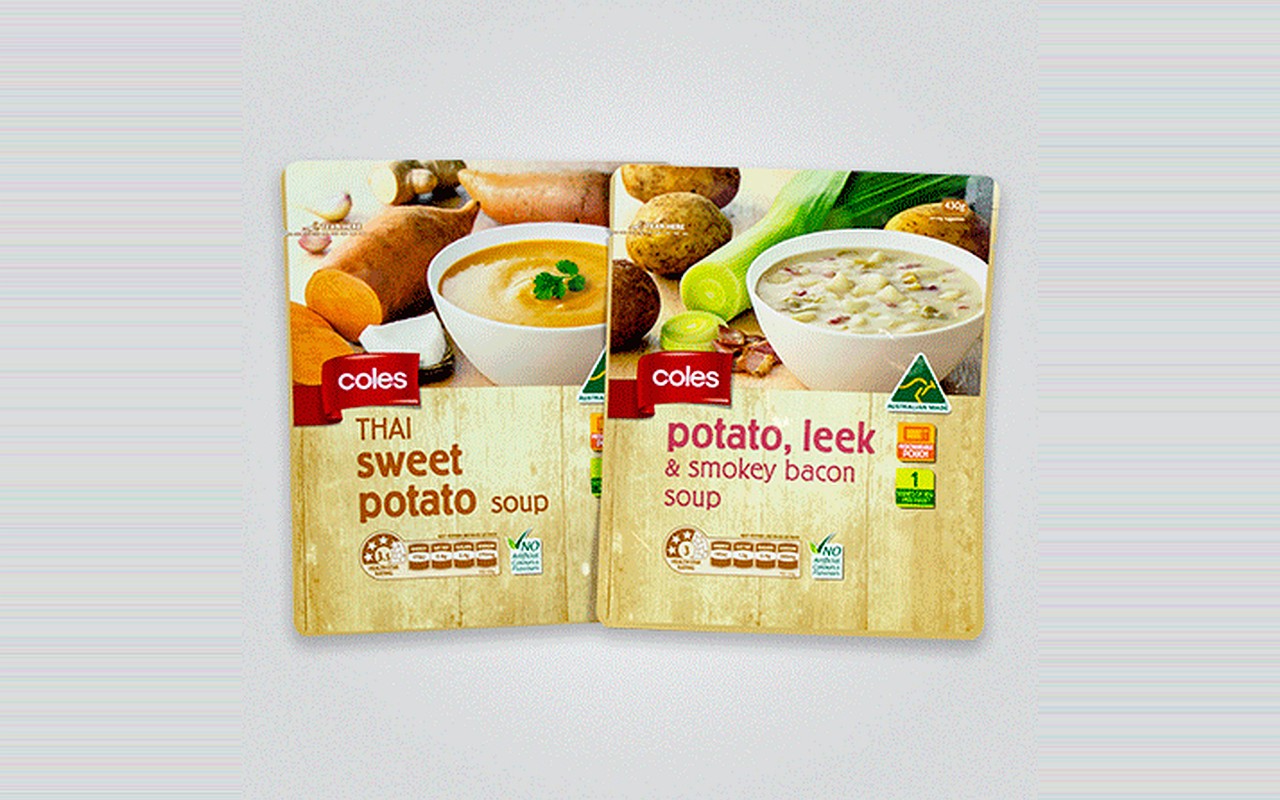
Retort Pouches for Shelf-Stable Food
Laminated pouches engineered to go through full sterilization at 121 °C and come out flat, sealed and still printed sharp — the modern replacement for the steel can.
What a retort pouch has to survive
A retort pouch is not a strong bag. It is a package that has to spend forty to sixty minutes inside a pressurized autoclave at 118 to 125 °C, in saturated steam or superheated water, while the food inside boils, expands and pushes on every seal — and then come out looking like it was never touched.
That is a materials problem, not a printing problem. The ink has to be a retort-grade system that will not blush or lift. The adhesive has to be a two-component polyurethane rated for the cycle, because a standard laminating adhesive delaminates into a cloudy tunnel the first time it sees steam. The sealant has to be a retort CPP with enough hot-tack to hold while the headspace expands. Change any one of the three for a cheaper grade and the pouch fails — usually not on the trial, but three months into production.
This is why we ask for your process sheet before we quote. Sterilization temperature, hold time, overpressure, cooling method and whether you run water immersion or steam decide the structure. We would rather lose a quote than sell a laminate that will not hold your cycle.
Choosing between a foil and a clear retort structure
The classic high-barrier retort structure is PET / aluminium foil / nylon / retort CPP. The foil layer gives an absolute oxygen and light barrier, which is what buys you an eighteen- to twenty-four-month ambient shelf life on a sauce, a stew or a pet food. The nylon layer is what gives the pouch its puncture and flex-crack resistance so the foil does not pinhole when the pouch is handled.
A transparent retort structure — PET / nylon / retort CPP, sometimes with a transparent barrier coating — lets the customer see the product, which is worth real money on a premium ready meal or a rice pouch. The trade-off is shelf life: without foil you are typically looking at nine to twelve months rather than twenty-four, and light-sensitive products fade.
Metallized film is the third option and it is the one most often chosen wrongly. Metallized PET is not foil; its barrier is good but not absolute, and a full retort cycle can craze the metallization. We use it selectively, for shorter shelf lives and gentler cycles, and we say so up front.
Formats, fitments and how the pouch runs on your line
We build retort pouches as three-side-seal flat pouches, stand-up pouches with a folded gusset bottom, and spouted pouches for pourable products. A stand-up retort pouch needs a heavier bottom gusset than a cold-fill doypack, because the gusset is the first thing the autoclave attacks.
Notches, laser scores, tear lines, hang holes, zippers rated for retort and microwave steam vents are all available. A steam vent is worth specifying early: it changes the top seal geometry, and retrofitting one to an existing die is a new die.
If you are filling on your own equipment, tell us the machine make and model. A pouch that is perfect on paper can still be unrunnable on a specific rotary filler because of pouch stiffness, coefficient of friction or gusset depth. We send a trial roll or a pilot lot of pouches so the first production day is not the first time your line has seen the film.
What this product includes
Typical applications
- Ready meals, stews, curries and rice that must sit on an ambient shelf
- Sauces, moles, salsas and soup bases replacing glass jars or cans
- Wet pet food in single-serve and multi-serve portions
- Seafood, tuna and poultry in pouch instead of can
- Beans, pulses and pre-cooked grains for foodservice
- Institutional and military-style meal components
Films, resins and finishes
- PET 12 µm, printed reverse for a protected image
- Aluminium foil 7 – 9 µm for absolute oxygen and light barrier
- Nylon (BOPA) for puncture and flex-crack resistance
- Retort CPP sealant 60 – 100 µm, hot-tack rated
- Two-component polyurethane retort laminating adhesive
- Retort-grade ink systems with matte or gloss overprint varnish
Frequently asked questions about retort pouches
Yes, when it is retort ink printed on the reverse side of the outer PET so the image sits inside the laminate rather than on the surface. Surface-printed film and standard ink systems blush, lift or scuff in a retort cycle, which is why we reverse-print every retort job as standard.
With a foil structure and a properly validated seal, eighteen to twenty-four months ambient is normal for most sterilized foods. A transparent structure typically gives nine to twelve months. The final number belongs to your shelf life study, not to us — but the barrier we supply is what makes that study possible.
A transparent or metal-free structure can, and we can add a self-venting seal so the consumer does not have to cut a corner. A foil structure cannot go in a microwave. If microwave reheating is part of your promise, tell us at the quoting stage, because it eliminates aluminium foil from the options.
Typically 300 to 500 kg of finished laminate per design, which is a large number of pouches for a single-serve size. Tooling — cylinders and pouch die — is a separate one-time cost. We will tell you the exact break point for your size on the quote.
Let's spec your packaging
Send us the product, the process and the volume. You get a structure proposal, a tooling cost and a lead time within 24 business hours.