
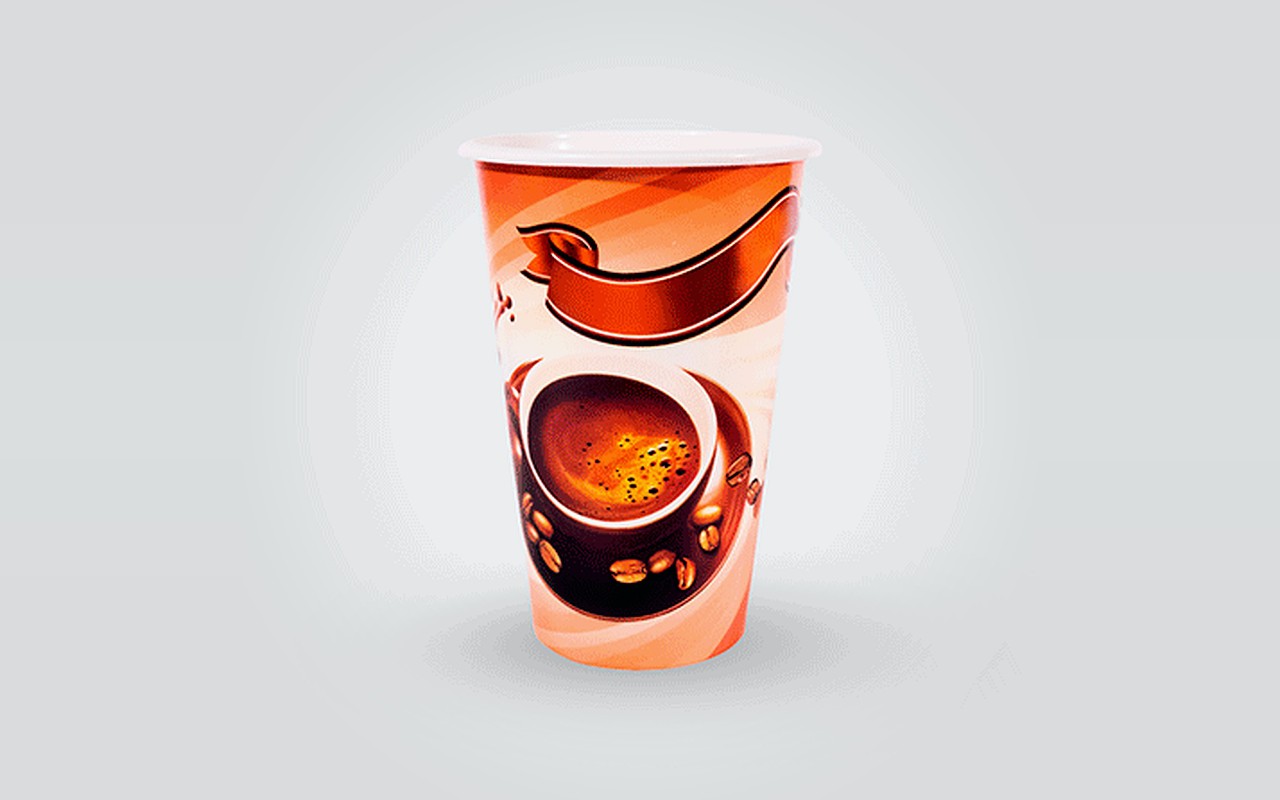
Printed Cup Series & Transparent Cups
The cup, the sleeve and the lid are one purchase and one colour conversation — printed cup series, crystal-clear transparent cups and everything that closes them.
Print on the cup, print on a sleeve, or print on a label
There are three ways to decorate a cup and they suit three different businesses. Direct offset or dry-offset printing on the cup wall is the cheapest per unit at volume and gives a clean, durable image — it is the right answer for a high-runner SKU that will not change artwork for a year.
A shrink sleeve gives you full 360-degree photographic coverage, a tapered shape held perfectly, and the ability to change flavour or season without touching the cup tooling. It costs more per unit and it needs an applicator, but it turns one plain cup into an unlimited SKU family.
A wrap-around or pressure-sensitive label is the flexible middle: low tooling cost, fast to change, good for launches and limited runs. We supply all three, and we will tell you which one is economically right at your volume rather than which one we would rather sell.
Transparent cups: when the product is the graphic
For layered desserts, fruit cups, parfaits, cold coffee, boba and salads, the product sells itself and the packaging job is to get out of the way. A crystal-clear PET or PP cup with a small printed band or a clear label lets the layers do the marketing.
Clarity is not free. PET gives the highest clarity and the best gloss but cannot take a hot fill. PP takes heat and is microwavable but is naturally hazier — modern clarified PP has closed much of that gap. PS is bright and inexpensive and is where most single-use dessert cups still sit, though several markets are restricting it.
The pairing with the lid is the part that is usually neglected. A transparent cup with a fogged lid looks worse than an opaque cup, so if you are showing the product, specify anti-fog lidding at the same time. We seal your cups in our lab and show you the result before you buy either component.
Volumes, tooling and stock versus custom
Stock cup sizes cover most needs and carry no tooling cost, which means a new product can launch quickly with a printed sleeve or label on a standard cup. A custom cup shape — a unique taper, an embossed base, a proprietary footprint — is a mould, and a mould is a serious one-time investment that pays back only at real volume.
We will be blunt about which side of that line your project is on. The majority of dessert and foodservice brands are better served by a stock cup decorated distinctively than by a custom cup they cannot afford to re-tool.
Whichever route you take, the cup, the lidding, the sleeve and the carton label are all quoted on one document, run against one colour target and shipped together. That is the practical reason customers consolidate this category with us.
What this product includes
Typical applications
- Yogurt, flan, gelatin and layered dairy desserts
- Fruit cups, parfaits and cut-fruit retail packs
- Cold coffee, boba, smoothies and juice in foodservice
- Ice cream, sorbet and frozen dessert portions
- Salads, dressings and deli side portions
- Promotional and seasonal cup programmes for chains
Films, resins and finishes
- PET cups for maximum clarity in cold applications
- Polypropylene cups for hot fill, microwave and rigidity
- Polystyrene cups for economical single-use dessert formats
- PLA and fibre-based cups where a compostable claim is required
- Matched peelable, anti-fog and foil lidding
- Shrink sleeves, wrap labels and direct print decoration
Frequently asked questions about printed & transparent cups
Yes. Plain stock cups are available by the case, and many customers buy plain cups plus printed lidding or a sleeve, which is often the cheapest route to a branded pack at moderate volume.
That is the main reason to buy them together. We seal your cup with the proposed lidding on a lab head, measure the peel force and give you both components as a tested pair rather than two hopeful purchases.
Polypropylene. PET distorts at hot-fill temperatures and PS is worse. If the product is filled hot or reheated in a microwave, the cup, the lid and the sealant all need to be rated for it, and we specify the three together.
Only at volume. A mould is a five-figure one-time cost with a long lead time. Below several million units a year, a stock cup with a distinctive sleeve almost always wins on total cost and on speed to market, and we will show you the numbers both ways.
Let's spec your packaging
Send us the product, the process and the volume. You get a structure proposal, a tooling cost and a lead time within 24 business hours.